
Ferrari’s blend of heritage and cutting-edge tech shines through in its newest release, the 12Cilndri, successor to the 812 Superfast, unveiled in Miami. With a focus on the 12-cylinder engine, the 6.5-liter, 65-degree powerplant is a refined version of Ferrari’s F140 V-12, delivering 819 naturally aspirated horses at 9,250 rpm and 500 pound-feet of torque at 7,250 rpm, with a redline of 9,500 rpm—no hybrid assistance needed to meet emissions standards.
It closely resembles the engine found in the 812 Competizione, featuring titanium connecting rods and a valvetrain that replaces hydraulic lifters with a rigid system utilizing roller finger followers. Notably, it incorporates a technology called “Aspirated Torque Shaping,” using electronics to adjust the torque curve in the third and fourth gears.
Teamed with the engine is an eight-speed dual-clutch gearbox positioned at the rear, boasting 30 percent faster shifts compared to the 812’s transmission. Considering the 812 was renowned for its swift gear changes, the enhancement is intriguing. The switch to taller 21-inch tires effectively reduces the gear ratios by 5.0 percent, aiding acceleration. Ferrari claims a 0-62 mph time of 2.9 seconds and a 0-124 mph time of under 7.9 seconds. The Spider model achieves slightly slower times at 2.95 seconds and 8.2 seconds, respectively. Both models have a top speed exceeding 211 mph.
Comparatively, the 12Cilindri edges out the 812 Superfast in size, albeit with a slightly shorter wheelbase. Its design echoes elements from the Roma, featuring heightened technical intricacies. Notably, the black panel upfront, reminiscent of the plexiglass panel on early 365 GTB/4 Daytonas, adds to its Daytona-esque aura.
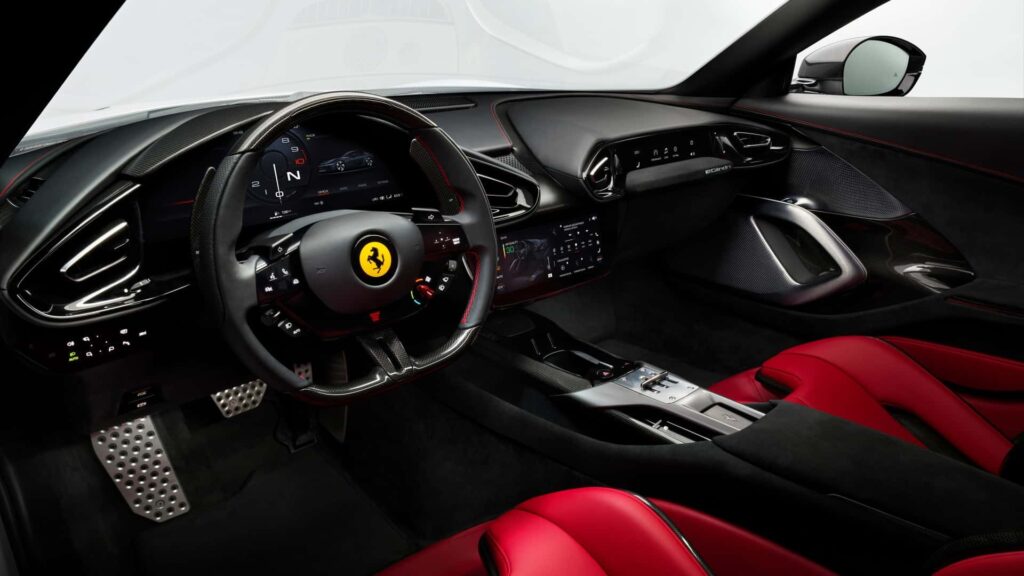
Internally, familiar Ferrari elements include the adorned steering wheel with controls, while distinguishing itself with a central infotainment display—a departure from recent models. Otherwise, the interior resembles that of the Purosangue, sans rear seats.
The 12Cilindri comes equipped with Ferrari’s newest chassis control tech, featuring Side Slip Control 8 for swift tire grip estimation. Its independent four-wheel steering allows rear tires to steer oppositely. Wheel size increases to 21 inches, with 275/35ZR21s at the front and 315/35ZR21s at the rear. Buyers can opt for Michelin Pilot Sport S 5 or Goodyear Eagle F1 Supersport tires.
Ferrari provides only a dry weight, excluding necessary fluids for operation, obscuring the exact weight of the 12Cilindri. The coupe’s dry weight is 3,459 pounds, while the Spider’s is 3,571 pounds, suggesting a total weight of 3,700 to 3,800 pounds when fully fueled. Additionally, Ferrari claims the 12Cilindri is 15 percent stiffer than the 812.
Unsurprisingly, this V-12 Ferrari comes with a hefty price tag. The coupe version of the 12Cilindri is priced at $423,000 (€395,000), while the convertible costs $466,000 (€435,000). It’s safe to assume that the 12Cilindri is already sold out for years to come, a common trend with Ferraris, especially those equipped with V-12 engines.
Source and Images: Motor1